If a company faced a moment like this, it would run a project: research the landscape, set the goal, plan the route, and bring in support for the unfamiliar parts. You've run that project, or commissioned it, more than once. Almost nobody runs it for themselves. CompoundCraft is that project, built for one client: you. Here's how it runs.
The assessment is not a personality quiz. It doesn't sort you into a type or grade your strengths. It reads a situation: your runway, your income needs, your time, your network, your appetite for the work around the work, and the tensions between them.
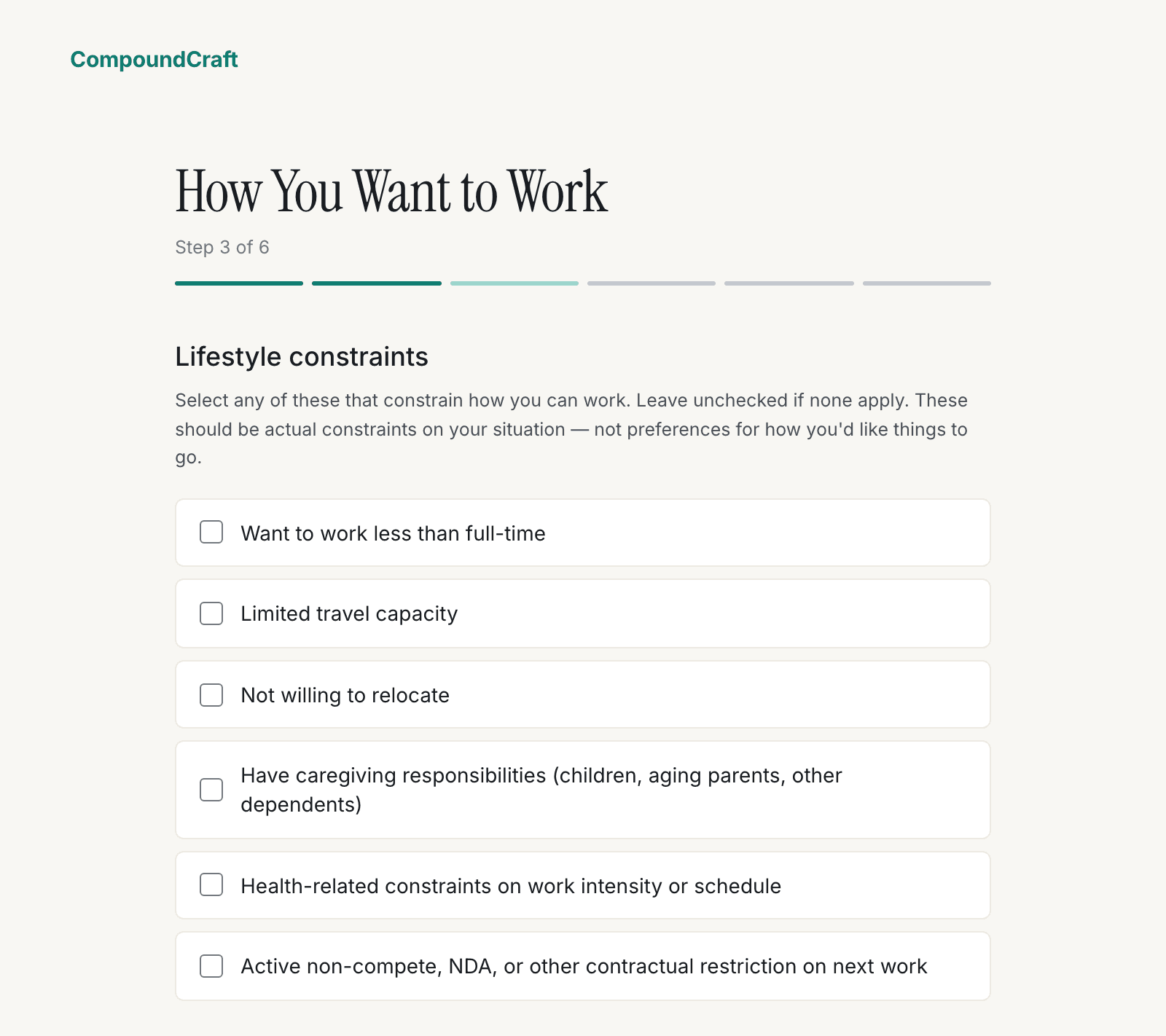
It's worth saying how it's built. The assessment pairs AI with an authored instrument. The questions, the framework, and the standard for what a useful read sounds like came from twenty years of watching senior people navigate this exact moment, then tested on real people in real transitions and revised by what they said back. AI holds the entire situation in view at once; the judgment it applies is authored.
What comes back is a read: where you actually stand, which tensions matter most, and which pathways deserve your attention first, weighed across eleven dimensions and all seven pathways, in three passes. You can take it before deciding anything, including whether to join.
The pathways
Fractional leadership. A senior seat for a fraction of the week, for companies that need the judgment but not the headcount.
Independent consulting. Defined problems, defined engagements, sold on your expertise.
Board and advisory work. Your judgment, applied at the cadence of meetings rather than weeks.
Expert networks. Paid hours sharing what you already know. Often the fastest first dollar.
Entrepreneurship. Building something of your own.
Teaching and knowledge transfer. Your expertise, taught: workshops, courses, writing.
Staying employed, strategically. A job held on purpose, on your terms, rather than by default.
Which pathways deserve your attention depends on your constraints, and the smart first move is usually one step from where you stand, not a leap. Almost nobody lands on exactly one: most working answers are portfolios, an anchor engagement here, advisory work there, teaching in the gaps. The platform assumes that from the start.
Every pathway comes with market intelligence: real rates, time to first income, how the work actually arrives, what it demands. Each claim shows where it came from, and where the evidence is thin, it says so. Part of that research is free to read, no account needed.
It looks in both directions: at what's happening to senior roles in your profession, and at the markets you might enter, pathway by pathway. The research follows a repeatable protocol, so as markets move, the intelligence moves with them.
Small bets
The fastest way to learn whether a path fits is rarely more research. It's a small bet: the smallest thing that buys the strongest signal, before you spend real time or money. A few paid expert calls before deciding consulting is your path. One workshop taught before any course gets built. Two conversations with people who'd buy what you'd sell, before any website exists.
The platform's techniques are a library of these, sized and sequenced for leverage. None of it is assigned: some you'll run, others you'll read and decide from the armchair, and deciding not to run one is also a finding. Most can be done quietly, while employed, without announcing anything to anyone.
The shortcuts
Some of what slows people down is just finding things: which expert networks are worth joining, which marketplaces actually produce consulting work, where fractional roles get filled, who handles the invoicing, what you do about health insurance.
The resource catalog is the curated set: the services, platforms, and communities that actually help independent professionals, matched to where you are, from first exploration to a running practice. A short list of what's worth your time, held to the same bar as everything else here, growing as better answers turn up.
None of this happens alone. The champion map sorts your network, a thousand loose contacts, into the buyers, connectors, and scouts who actually move each pathway. A private peer layer is being assembled alongside it; there's more about that on the home page.
Is this for you?
It fits if you're in the open moment: the question has surfaced, the direction hasn't been chosen, and you want to decide with evidence instead of adrenaline. Some people were handed the moment; others are planning toward it years before they need it. The framework doesn't care which; your constraints are the inputs either way.
It's probably not a fit if your practice is already up and running: you've positioned, priced, and sold work you originated, and what you need now is repetition, not evaluation. For that, read our newsletter, The Sustainable Practice, or if you want to build the practice one-on-one, that's what coaching is for.
That's the whole method: an honest read, real evidence, small bets, shortcuts, and people around the question. Start with the read. It costs nothing and tells you the most.
Take the assessment→